The proposed death tax explained
Andy Burnham is considering replacing IHT with a flat 10% levy on all estates. We break down who wins, loses, & what this "death tax" means for families navigating probate in the near future.

The proposed death tax explained: What Andy Burnham’s flat levy could mean
On 27 July 2026, The Telegraph reported that Andy Burnham was considering a flat 10% “death tax” on all estates to fund a new National Care Service. Within 24 hours, Downing Street had moved from declining to rule it out to insisting there were “no plans for this.” The proposal may have retreated for now the meantime. But the direction of travel on estate taxation under the new Prime Minister is clear enough to warrant paying close attention.
This post sets out what was proposed, what it would mean in practice for different families, and what steps are sensible to take regardless of what Burnham ultimately announces.
Contents
- What is being proposed?
- How the current IHT system works
- Who wins and who loses under a flat 10% levy
- The gross estate problem
- What happens to farmers and business owners?
- The double death tax risk
- What about gifting?
- The cashflow problem estates already face
- What can families do right now?
What is being proposed?
As reported by The Telegraph‘s senior political correspondent Dominic Penna on 27 July 2026, Burnham hinted at a 10% flat levy on all estates passed on after death. This would replace the current inheritance tax system entirely. The revenue would fund a new National Care Service, with the Prime Minister’s own estimates putting the cost at up to £18.7 billion a year.
This is not a new idea for Burnham. As Health Secretary under Gordon Brown in 2009, he proposed an almost identical scheme but this collapsed after the Conservatives branded it a “death tax”, forcing a withdrawal. The phrase has defined the debate ever since. As the current PM Andrew Burnham has made social care reform the centrepiece of his domestic agenda.
On Monday 28 July, Downing Street stopped short of ruling the idea out. When asked whether the PM remained committed to the levy, his official spokesman said:
“I’m just not going to get ahead of his update on this issue, which will come later in the week. He’s also been clear about the consequences of not doing it, which is that the NHS would collapse under the weight of having to care for people not really needed in the NHS system.”
By Tuesday 29 July, the same Downing Street had shifted, with a government spokesman insisting: “There are no plans for this. Fixing our social care system will require building a broad consensus.”
The rapid reversal suggests internal pressure but not a permanent retreat. Burnham told the BBC’s Laura Kuenssberg he would use “whatever political capital I have” to reform social care and promised “major changes” within three years. The Treasury currently raises close to £9 billion a year from inheritance tax, against forecast social care spending of £39 billion by the end of the decade. The funding gap is real and will need to be addressed.
How the current IHT system works
Under current rules, inheritance tax is charged at 40% on the net value of an estate above the nil-rate band (NRB) of £325,000. An additional residence nil-rate band (RNRB) of £175,000 applies when a family home passes to direct descendants, and both allowances can be combined by married couples meaning a couple can effectively pass on up to £1 million free of IHT.
HMRC data shows that only around 4.6% of UK deaths resulted in an IHT charge in 2022–23. By 2026, the annual IHT take had risen to close to £9 billion as frozen thresholds and rising asset values pulled more estates into scope but it still represents fewer than one in twenty deaths. The proposed flat 10% levy would apply to every estate. That is a fundamental change in who pays and as the charts below show, it transfers the burden sharply downward.
Who wins and who loses under a flat 10% levy
The analysis below, drawing on calculations by Gravita’s tax team, shows the crossover point: a married couple with children would be worse off under the proposed flat levy until the total joint estate reaches approximately £1.35 million. Above that threshold, they pay less. The reform benefits wealthier estates and hurts more modest ones.
Tax paid on death — married couple with children
Current IHT vs proposed 10% flat levy. Assumes full NRB + RNRB (£1m combined). Source: Gravita, July 2026.
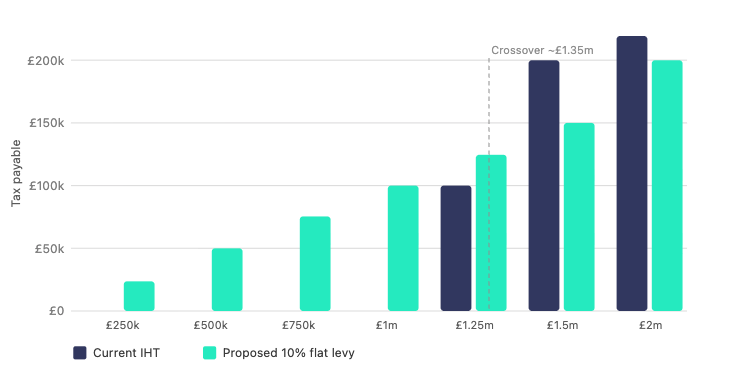
For context: a couple with a combined estate of £750,000 — a house, modest savings, small pensions — would pay £0 under current rules. Under the proposed levy, their family would face a bill of £75,000. A couple with a £2 million estate would currently pay around £400,000; under the flat levy, the bill drops to £200,000. The reform transfers the burden downward.
The gross estate problem
A further complication that has received little attention in the political commentary, is that the levy may apply to the gross estate rather than the net. Under current IHT rules, only the net value (assets minus debts, including mortgages) is taxed. The proposed 10% charge may apply before debts are deducted.
Consider a property worth £500,000 with a £400,000 mortgage. The net equity is £100,000. Under current rules, assuming no other assets, the estate pays no IHT. Under a gross-basis 10% levy, the tax bill would be £50,000. This would be levied on the property’s full value, not the equity the family actually holds.
Tax on a £500,000 property — how mortgage debt affects the bill
Current IHT vs proposed 10% gross levy at varying mortgage balances. Source: Gravita, July 2026.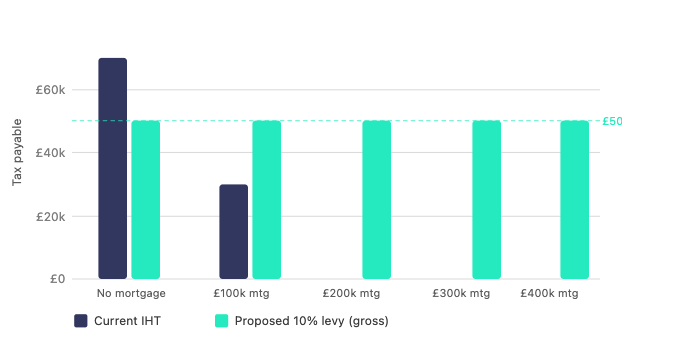
This is not a hypothetical edge case. First-time buyers who purchased in high-value areas in the past decade are precisely the demographic carrying large mortgages alongside significant gross property values. A flat levy on gross value would mean paying tax on equity they do not own.
What happens to farmers and small business owners?
The current system includes Agricultural Property Relief (APR) and Business Property Relief (BPR), which allow qualifying farms and businesses to pass on assets with significantly reduced IHT exposure. These reliefs were already restricted in April 2026 but they still exist. Under the proposed flat levy, they may disappear entirely.
It is worth remembering the context. Agricultural assets worth more than £2.5 million were brought into IHT scope under Keir Starmer’s government a change that prompted fierce resistance and a record high in rural business closures last year. Under Burnham’s proposed flat levy, small family farms currently below any IHT threshold would face a bill they have never encountered before.
Tax on a qualifying farm or family business
Current rules (post-April 2026 APR/BPR) vs proposed 10% flat levy with no reliefs. Source: Gravita, July 2026.As Gravita’s tax team notes, a small farmer currently covered by APR could go from paying no IHT to facing a bill of up to £250,000 on an asset that cannot easily be sold without ending the business. The irony is that for the very largest farms and businesses (joint estates around £5 million), the flat levy and the current reformed rules converge at roughly the same number. The proposal hurts small family operations most.
The double death tax risk
A separate but related proposal from Louise Haigh a close ally of Burnham and former Transport Secretary, would abolish the capital gains tax (CGT) uplift on death. Under the current system, when someone inherits an asset, its CGT base cost is reset to market value at the date of death. If this uplift were removed, beneficiaries would inherit the asset’s accrued CGT liability alongside the asset itself.
Accountancy firm Begbies has estimated that if both policies were enacted simultaneously, combined effective tax rates on some assets could exceed 62%. That is the “double death tax”, a levy on the estate itself plus a CGT bill the beneficiary inherits with it.
What about gifting?
One of the most important planning tools under the current IHT regime is the seven-year rule: gifts made more than seven years before death fall outside the taxable estate. There is also an annual exemption (£3,000 per year) and various smaller reliefs.
The current proposals do not address whether any of this would survive a flat levy. If it applies to all assets at death with no gifting rules, those with sufficient wealth to give assets away early would face no tax at all. Those who cannot afford to give assets away or who die unexpectedly would bear the full burden. That structural inequity is built into the proposal as it stands.
The cashflow problem estates already face and how a flat levy makes it worse
One aspect largely absent from political commentary is the cashflow challenge. Under the current system, IHT is due within six months of death before the Probate Registry issues a grant of probate, and before estate assets can be released. Families routinely face a situation where they owe HMRC a significant sum but cannot access estate funds to pay it.
A flat 10% levy applied to every estate would create this same cashflow problem for millions more families who have never previously faced it. A family with a £600,000 estate ( a property, modest savings, no liquid cash outside the estate ) would face a £60,000 tax bill due before probate is granted.
This is precisely the situation Level was designed to address. An Inheritance Tax Loan from Level releases funds to pay HMRC before the estate is settled, with no repayment required until the estate completes. An Estate Advance covers the wider costs of administration in the meantime. Under the proposed changes, the number of families needing this kind of bridge would increase substantially.
What can families do right now?
It is important to be clear: this is not yet law. The proposals are under active debate, Downing Street has stated there are “no plans,” and any legislation would need to pass through Parliament. The current IHT rules still apply today.
That said, the direction of travel is clear enough to warrant acting on planning that is sensible regardless of what Burnham ultimately announces.
- Make or update your will. Especially critical for unmarried couples, who have no automatic inheritance rights under the current intestacy rules and who would face the same issue under any flat levy regime.
- Understand your current IHT position. Use Level’s Inheritance Tax Calculator to get a clear picture of what your estate would owe today, and what it might owe under the proposed changes.
- Consider gifting within current rules. The annual £3,000 exemption, the seven-year rule, and small gifts allowances are available now. If a flat levy with no gifting relief is introduced, these opportunities may disappear.
- Speak to a specialist solicitor. Estate planning under a changing tax regime requires professional advice. Level works with over 780 partner law firms across the UK and your solicitor can refer you to Level if estate funding becomes relevant.
- Be aware of the cashflow risk. If you are an executor or administrator where IHT is already due or where it would become due under the proposed changes – a Level Inheritance Tax Loan can bridge the gap between the tax deadline and the release of estate funds.
Last reviewed: August 2026. This article is for informational purposes only and does not constitute legal, tax or financial advice. Tax rules can change and their effect depends on individual circumstances. For advice specific to your situation, consult a qualified solicitor or tax adviser. Level references tax analysis published by Gravita (Michaela Lamb, Partner – Tax, 28 July 2026) and political reporting by Dominic Penna, Senior Political Correspondent, The Telegraph, 27 July 2026. All charts are illustrative based on publicly available proposal parameters. No confirmed policy has been published; Downing Street stated on 29 July 2026 that “there are no plans for this.”