Being a Beneficiary of a Will Explained
To find out what being a beneficiary means, read on. This guide takes you through what happens next and what you can expect.


What is a Beneficiary of a Will? Your Rights and Next Steps Explained
If you are a beneficiary of the Will of somebody who has recently passed away, you may be wondering what the next steps are and when you might expect to receive your inheritance. This guide takes you through what being a beneficiary means, what happens next, and what you can expect throughout the process.
Please note: the information in this guide applies to the rules for executing a Will in England and Wales. Different rules apply in Scotland and Northern Ireland.
What happens first?
Before you receive anything, probate will normally need to have been obtained first — giving executors the legal right to start disposing of estate assets and distributing the inheritance in line with the wishes outlined in the Will.
It is an executor’s job to apply for probate. For more on that role, see our guide to being an executor and our probate guide.
There are exceptional circumstances where probate may not be required — for instance, if the deceased only left savings, owned assets jointly with someone still alive, or owned land or property as a joint tenant.
What does being a beneficiary mean?
In the context of probate, a beneficiary is a person or entity designated to receive a portion of the estate in a person’s Will. Beneficiaries may be named directly, or included without being named — for example, “I leave to my grandchildren…”.
If you have been left an inheritance and want to understand how inheritance tax works, read our inheritance tax guide.
What is a residuary beneficiary?
A residuary beneficiary receives the “residue” of an estate — what remains once all debts, expenses, and specific gifts have been settled by executors. Any beneficiary who has been left a certain percentage of the estate receives this leftover amount, which is why the term “residuary beneficiary” is used.
What are residuary beneficiaries’ rights?
Before probate has been granted, a beneficiary has a legal right to be informed that they are named in a Will, and to be told how much they are entitled to receive (though this will be an estimate at this stage). They also have the right to know who the executor is, and it is common practice to be given an estimate of how long probate might take.
Pecuniary beneficiaries are those entitled to receive a specific sum of money from an estate — for example, a Will might state that a child is to receive £20,000. Pecuniary beneficiaries will generally need to wait longer than beneficiaries of specific gifts.
Who contacts beneficiaries of a Will?
It is the executor’s responsibility to notify beneficiaries. The best way to find out if you are a beneficiary is to ask the deceased’s executor or solicitor. If no executors named in the Will are still living, someone will be designated by the authorities as the Administrator of the Estate, and the role of notifying beneficiaries will fall to them.
When do beneficiaries get notified?
Under the law of England and Wales, there is no specific time frame for notifying beneficiaries. It should happen early in the process, once the Will has been found legally valid and probate has been granted. A beneficiary does have a legal right to know they are named, and there can be serious legal implications if they are never informed.
Are beneficiaries entitled to a copy of the Will?
Beneficiaries are not legally entitled to see the Will until after probate has been granted, at which point it becomes a public document available from the Probate Registry upon request.
Despite what films and TV portray, Wills are not formally read out to family members after a death. Only executors have a legal right to read a Will before probate is granted — anything else disclosed before that point is at the executor’s discretion. Once probate has been granted, executors are required to keep accounts and show them to any beneficiaries who ask.
Can a beneficiary be removed from a Will?
Beneficiaries can be written in and out of a Will while the estate owner is alive. Once the estate owner has died, named beneficiaries cannot be removed.
What happens when you jointly inherit a property?
If you jointly inherit a property with other beneficiaries, you must all agree on what to do with it — whether to sell it, live in it, or rent it out. Reaching a decision that all beneficiaries are happy with can often be easier said than done, and in some cases it may be necessary to seek legal advice if an agreement cannot be reached.
Do beneficiaries of a Will pay tax?
Beneficiaries do not pay inheritance tax on what they receive — this is settled by the executor before the estate is distributed. However, other taxes may apply depending on what you inherit and what you do with it.
| Tax type | When it applies | Who pays it |
|---|---|---|
| Inheritance tax (IHT) | On estates above £325,000 | Executor or personal representative — not the beneficiary |
| Income tax | On income generated from inherited assets (e.g. rental income, dividends from shares) | Beneficiary |
| Capital gains tax (CGT) | If you sell an inherited property or asset at a profit | Beneficiary |
| Stamp duty | Not payable when inheriting a property | Not applicable |
Inheriting a second property
If inheriting a property means you own two homes, you must nominate one as your main residence and inform HMRC within two years of inheriting. If you fail to do so and subsequently sell one of the properties, HMRC will decide which was the main residence and charge capital gains tax on the other.
What happens if a beneficiary dies?
If a beneficiary dies before the testator (the person whose Will it is), the gift usually lapses. The deceased beneficiary’s estate will not receive anything, and whatever they would have inherited typically falls back into the residuary estate to be redistributed among the remaining beneficiaries. There are some exceptions to this rule.
What if a beneficiary dies after the testator? The survivorship clause
Many Wills contain a survivorship clause, which states that a beneficiary must survive the deceased by a set period — usually 28 days — in order to inherit. This prevents assets passing through two estates in quick succession.
If a beneficiary survives for the full survivorship period but then dies before the inheritance has been received, the inheritance passes into their own estate and is inherited by their beneficiaries.
Who gets paid first from an estate?
Before any inheritance can be received, executors must settle all outstanding obligations in the following order:
- Debts and taxes — including utility bills, any outstanding inheritance tax, and funeral costs, all of which are paid from the estate.
- Pecuniary legacies — specific gifts of money or particular items such as jewellery.
- Residuary estate — whatever remains is then distributed among residuary beneficiaries.
How long does it take to receive inheritance money in the UK?
On average, it takes nine to twelve months for beneficiaries to start receiving their inheritance, though this varies depending on the complexity of the estate. The lengthiest part is usually waiting for probate to be granted. After that, it typically takes around six months for the estate to be fully distributed. If there is no property to sell, the process can be considerably quicker.
If waiting is not an option, Level’s Inheritance Advance may enable you to access a portion of your inheritance sooner.
How do I receive my inheritance?
Once probate has been granted, the executor has legal control over the estate and can begin distributing it to beneficiaries. However, before probate can be granted, any inheritance tax due must be paid to HMRC — which means the executor must find the funds to pay IHT before they can access the estate.
To help executors pay IHT and unlock the estate, Level offers an IHT Loan paid directly to HMRC, with no personal liability to the executor.
Can I get my inheritance early?
Yes. Level’s Inheritance Advance is an award-winning product that enables beneficiaries to access up to 60% of their inheritance before probate has been granted. There are no credit checks, no charge over property, no personal liability, and no monthly repayments. The advance is repaid from estate funds once they are ready to distribute.
Get in touch with Level to find out more.
What if a beneficiary is living in an inherited house before the inheritance is finalised?
It is common for someone to die and leave a beneficiary living in their property before they have technically inherited it.
If the property has a mortgage, the beneficiary should contact the mortgage provider to explain the situation. Most lenders extend a grace period where payments are suspended until the estate has been distributed. Even if a beneficiary inherits a property they do not live in, they automatically become responsible for meeting any mortgage payments.
If a beneficiary inherits a property that someone else is living in, arrangements should ideally be made for the occupant to vacate. If this is not possible, it may be necessary to apply to the court for possession or an order for sale. A claim for occupation rent can also be made in the meantime. When there is a dispute over a property, speaking to an inheritance dispute lawyer is advisable.
Who inherits if there is no Will?
If somebody dies without leaving a valid Will, the rules of intestacy are used to determine who benefits from the estate. A surviving spouse or civil partner is first in line; if the deceased left no surviving descendants, the partner inherits the whole estate.
If there are surviving children and the estate is worth more than £270,000, it is divided between the surviving partner and the children. In this case, the partner would inherit:
- All personal property and belongings
- The first £270,000 of the estate
- Half of the remaining estate
For a full breakdown of intestacy rules, read our guide to intestacy rules.
How can Level help you with probate?
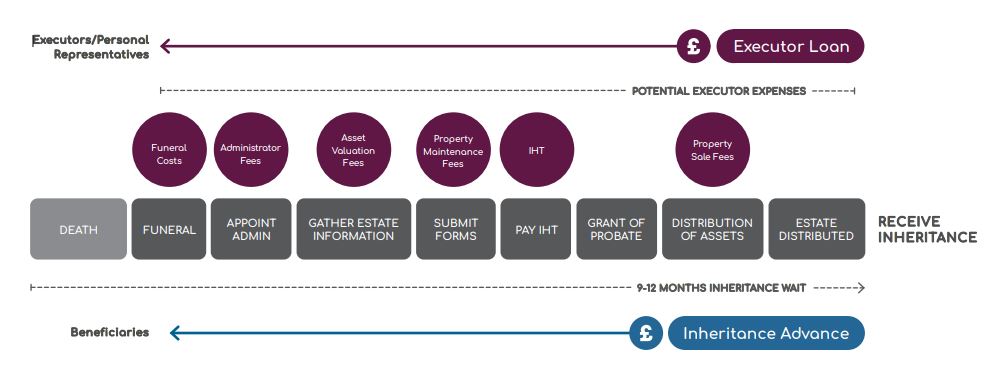
The stages from death to distribution with IHT payment highlighted
Interested in applying for funding?
Apply now using the button below. A member of the team will review your information and arrange a time to speak with you.
Apply for funding today