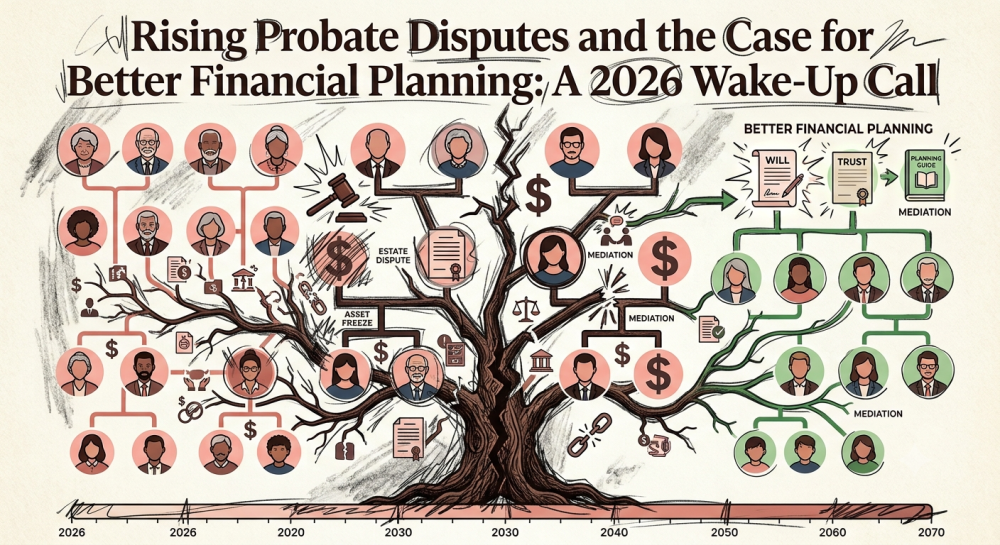
Inheritance / Probate Disputes Explained
How does a probate dispute work, and under what grounds can someone dispute?


Probate (or Inheritance) Disputes Explained
Please note: this guide applies to the rules for contesting wills and intestacy in England and Wales. Different rules apply in Scotland and Northern Ireland.
According to research by Direct Line Life Insurance, 12.6 million British adults would be prepared to dispute an inheritance and go to court if they disagreed with the division of their relative’s estate.
An inheritance dispute refers to a situation where the beneficiaries of a will, and/or the deceased’s family members, disagree about how the estate should be divided.
Since family disputes over inheritance can be time-consuming and expensive, Level has created a unique product, Private Client & Probate Dispute Funding, for those who cannot fund the costs associated with inheritance dispute resolution.
How do you challenge an inheritance?
If an inheritance dispute cannot be resolved by discussing the concerns or through mediation, it must be settled legally, and after hearing all sides of the argument, a judge will come to a decision.
Seeking the help of a specialist solicitor is the most effective way to navigate an inheritance dispute. Generally, these are the steps involved in dispute resolution:
- Mediation
- Court proceedings, if an agreement cannot be reached through mediation
Disputes resolved through mediation are typically faster and considerably less expensive than those that proceed to court. For more on the wider probate timeline and how disputes can affect it, see our guide to how long probate takes.
How much does it cost to dispute an inheritance?
Pursuing an inheritance dispute legally can be expensive, and our research shows that cost can deter people from seeking what is rightfully theirs.
Level’s Private Client & Probate Dispute Funding is a loan to cover the legal costs of disputing an inheritance, allowing you to pursue what’s rightfully yours. It is a unique financial product because, unlike others, we don’t ask you to jump through expensive hurdles to assess your dispute before deciding whether to approve it. There are no credit checks, no charges over property, no personal liability, and no monthly repayments.
The Private Client & Probate Dispute Funding loan has been designed to be simple, because dealing with the death of a loved one is hard enough.
What does contesting a will mean?
If someone has passed away and there is concern that their will does not reflect their true wishes, you can contest the will or defend a will claim.
In most circumstances where a personal estate has been left, a will can be contested by beneficiaries within 12 years of the person’s death. However, there are exceptions under the Inheritance (Provision for Family and Dependants) Act 1975, where claims for maintenance must be made within 6 months of the Grant of Probate.
What are the grounds for contesting a will?
If there are concerns as to whether a will is valid, the first thing to do is contact the witness or the executor of the will to obtain further detail about the circumstances of its execution.
A will can be challenged on the following grounds:
Lack of mental capacity
The deceased did not have the required mental capacity to make a will. The person challenging the will on these grounds must put forward real suspicions and proof that the deceased lacked mental capacity when the will was written. If they can do this, the burden passes back to those seeking to prove the will to show otherwise.
The requirements for mental capacity to make a will are set by the test for wills made after 1 April 2007, under Sections 1 to 3 of the Mental Capacity Act 2005. In a claim of this nature, the deceased’s medical records and the opinion of a suitably qualified medical expert are crucial.
Lack of knowledge and approval
The deceased did not properly understand and approve the contents of the will. Suspicious circumstances that can lead to challenging a will on this basis include where the deceased:
- Was hard of hearing or had a speech impediment
- Was visually impaired
- Had low levels of literacy
- Was vulnerable, and the will is particularly complex or unusual
Forgery and fraud
If it can be proved that the will has been forged, or that someone impersonated the testator, the contested will becomes invalid.
Rectification
A will may be challenged due to a clerical error or a failure to understand the testator’s intentions. If either of these is found, the court will rectify the will. A claim of this nature must be issued within six months of a Grant of Probate being issued.
Undue influence
It is up to those contesting the will to prove to a court that the will was written under coercion.
What are the requirements of a valid will?
Section 9 of the Wills Act 1837 confirms that, to be valid, a will must meet four requirements:
| Requirement | What it means |
|---|---|
| In writing | The will must be a written document – it cannot be made verbally |
| Signed by the testator | Or by someone else in the testator’s presence and at their direction |
| Signed in the testator’s presence | The testator must attend when the will is signed for it to be valid |
| Witnessed | The testator’s signature must be acknowledged in the presence of at least two independent witnesses |
Can you contest inheritance if there is no will?
If there is no will, or the only will that exists is determined to be invalid, the estate is distributed in line with the rules of intestacy.
However, it is possible to contest the provision of intestacy under the Inheritance (Provision for Family and Dependants) Act 1975 if there is a belief that the rules do not reflect what the deceased would have wished to leave as their inheritance.
Who can contest a will?
People eligible to challenge a will include:
- A spouse or civil partner of the deceased
- A former spouse or civil partner of the deceased, but not one who has formed a subsequent marriage or civil partnership
- A cohabiting partner – anyone living with the deceased as a spouse or civil partner for two years immediately before the death
- A child of the deceased, including adopted children
- Anyone treated as a child of the family – a person who was, at any time, part of a family in which the deceased stood in the role of a parent and treated them as a child of that family
- Any financial dependant – anyone who, immediately before the deceased’s death, was financially dependent on them, either wholly or partly
Can a family member contest a will?
Yes. Anyone who has grounds to contest an inheritance, as outlined above, can challenge the validity of a will.
What is the 1975 Inheritance Act?
The Inheritance (Provision for Family and Dependants) Act 1975, commonly referred to as the “Inheritance Act” or “1975 Act,” enables certain categories of people to apply to the court and make a claim against a deceased person’s estate, alleging that the deceased did not make reasonable financial provision for them.
How to handle inheritance disputes
Seeking the help of professional lawyers who specialise in inheritance dispute resolution is the most effective way to save money and time when challenging a will.
At Level, we can help you find a solicitor to support you in challenging a will or resolving an inheritance dispute. To find out more about our inheritance products and how we can help you fund your inheritance dispute, get in touch with us.
How you can find out more about probate dispute funding
Private Client & Probate Dispute Funding is a loan to cover the legal costs of disputing an inheritance, allowing you to get what’s rightfully yours. It is a unique financial product because, unlike others, we don’t ask you to jump through expensive hurdles to assess your dispute. There are no credit checks, no charges over property, no personal liability, and no monthly repayments.
Private Client & Probate Dispute Funding is designed to be simple, because dealing with the death of a loved one is hard.
How Level can help
Interested in applying for funding?
Apply now using the button below. A member of the team will review your information and arrange a time to speak with you.
Apply for funding today